
Department of Biological Sciences
Alice L. Kibbe Life Science Research Station
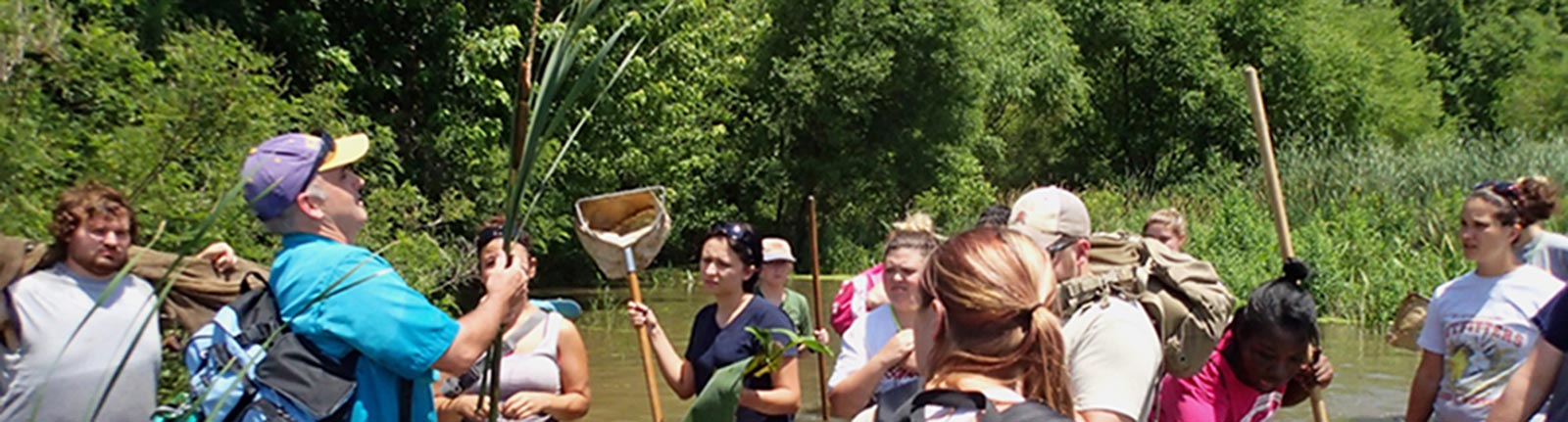
The Kibbe Life Science Research Station is a nature preserve, which is home to a diversity of plant and animal species. Kibbe provides students with hands-on experience in field research, as well as offering the general public an opportunity to commune with nature.
- About
- Contact & Affiliations
- Courses
- Directions
- Facilities, Use, Trail Map
- Natural Habitats
- Outreach and Recruitment
- Volunteer
- Videos
About
Dr. Alice Kibbe
Alice Kibbe had a dream of starting a field station at the site to promote teaching and research in field biology and ecology. Her ideals of promoting teaching, research and conservation are the cornerstones on which the Alice L. Kibbe Life Science Station has been built. Dr. Kibbe was a well-known botanist. She was Department Chair and Professor of Botany in the Biology Department at Carthage College from 1920 to 1956. Carthage College was located in Carthage Illinois, which is 18.5 miles east of the Station on US Highway 136. Dr. Kibbe purchased 115 acres in Hancock County, where she often took her students. Dr. Kibbe donated this land to Western Illinois University in 1964. Western Illinois University later purchased some adjacent land for a total of about 222 acres, which is the Kibbe Station.
Kibbe Station
The Illinois Department of Natural Resources owns 1458 acres adjacent to the Station that comprises Cedar Glen Natural Area and Sand Hills Nature Preserve. The total 1680 acres comprise the Kibbe Macro (KM) site. Macro sites are large areas recognized by the Illinois Department of Natural Resources as containing large tracts of ecologically significant native terrestrial and/or aquatic resources.
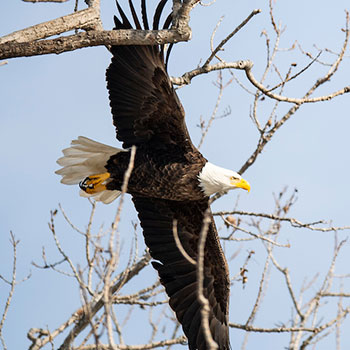
The Kibbe Macro Site contains uplands oak-dominated woodlands, sand hills with xeric sand prairie, limestone outcroppings/bluffs, hill prairies, mature floodplain forest and three miles of shoreline along the Mississippi River. Rocky intermittent streams are found in the valleys and glens. The site represents the largest piece of continuous landscape in the area. The area is a major wintering site for one of the largest concentrations of bald eagles in North America. Many of these eagles utilize a terrace forest in Cedar Glen Natural Area as a night roost. The adjacent section of the Mississippi River is a major flyway for migrating waterfowl and shorebirds. Pileated woodpeckers and a variety of other bird species nest and feed in the woodlands and prairies along the bluffs.
The Department of Biological Sciences at Western Illinois University began conducting summer classes in 1966, and has held summer sessions at the site ever since. Housing for undergraduate students and graduate students is provided in our multi-use/dormitory facility at the station, which includes full kitchen and shower facilities. Staying at the Station allows students to immerse themselves in field activities and research.
Donations
Please donate and become part of the strong Kibbe tradition of stewardship and excellence. Your donation will allow the station to purchase much needed items that will promote the education and appreciation of our natural resources and help sustain and grow the station. If you are interested in donating equipment to the station, please contact the station director, Dr. Sean Jenkins.
When donating online, type "Kibbe" in the "Make your selection(s)" field.
Contact WIU's Foundation and Development office for additional giving options.
Contact & Affiliations
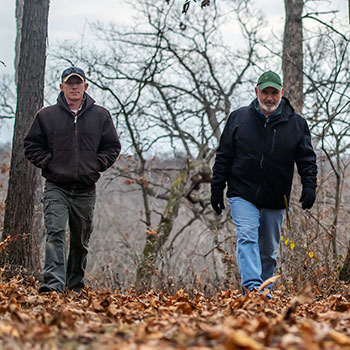
Dr. Sean E. Jenkins, Professor and Director of Kibbe Life Science Station
Office: Waggoner Hall 214
Phone:
(309) 298-2045
Email:
SE-Jenkins@wiu.edu
Neil Gillespie, Manager of Kibbe Life Science Station
Phone:
(217) 256-4519
Email:
ND-Gillespie@wiu.edu
Affiliations
The Alice L. Kibbe Life Science Station is funded as a separate budget through the Department of Biological Sciences at Western Illinois University. The Station Director, Dr. Sean Jenkins, and Mr. Neil Gillespie, are responsible for the coordination of activities and facilities at Kibbe. The Director holds an appointment with the Department and answers directly to the Department Chair.
The Kibbe Station Committee, comprised of the Director (who acts as chair of committee) and five faculty members, is responsible for major decisions about the operation and use of the Station. The Station Manager, Mr. Neil Gillespie , oversees maintenance, grounds keeping, site security at the Station and assists with coordination of activities and facilities at the Station. The University's physical plant provides additional support by means of building maintenance at the station.
The Station is a member of the Organization of Biological Field Stations (OBFS) . OBFS is an organization comprised of field stations and professionals from predominantly North America and Central America. Through annual meetings, a newsletter, occasional reports, and a field course opportunities display, OBFS provides a forum for discussion of field station management issues, the support of field education opportunities, and the promotion of issues of concern to field stations.
Courses
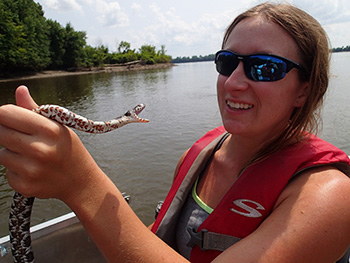
Summer courses have been offered at the station continuously since 1966. Courses, ranging from herpetology and ornithology to field mycology, fire ecology, and aquatic/wetlands plants, are offered during 2 four-week sessions each summer. In the future, station personnel would like to see the Station offer courses and workshops year round. In the near future, we would like to offer our classes to students nationwide through our own webpage and through our affiliation with the Organization of Biological Field Stations (OBFS). The OBFS produces a nationally distributed display and a web page that have updated lists of courses offered at member field stations.
Summer 2023
BIOL 451 Ecological Techniques. (3) Techniques and analytical methods used to examine terrestrial and aquatic communities are studied, including data analysis specific to those techniques. Includes field experience. Prerequisites: BOT 200 (C grade or better) and ZOOL 200 (C grade or better) or permission of the instructor.
- Star #79226
- Sean Jenkins
- 5/15/2023 - 6/8/2023
- MTWTh: 1:00 - 5:00 p.m.
- Additional Course Cost of $35
ZOOL 411(G) Entomology. (3) Principles of entomology, including classification, general biology, and morphology. Prerequisites: BOT 200 (C grade or better) and ZOOL 200 (C grade or better).
- Star #79743
- Richard Musser
- 5/15/2023 - 6/8/2023
- MTWTh: 8:00 a.m. - 12:00 p.m.
- Additional Course Cost of $35
BIOL 584 Advanced Ecological Techniques. (3) This course provides instruction on the applications of techniques and analytical methods to the evaluation and restoration of terrestrial and aquatic communities, including data analysis specific to those techniques. Includes field experience. Prerequisite: BIOL 350 or equivalent, or permission of the instructor.
- Star #79229
- Sean Jenkins
- 5/15/2023 - 6/8/2023
- MTWTh: 1:00 - 5:00 p.m.
- Additional Course Cost of $35
Directions
Kibbe is located near Warsaw, IL, on the bluffs of the Upper Mississippi River, just across the river from Keokuk, IA. The Kibbe Station is a proud member and supporter of the Warsaw Community . Warsaw has a rich historical heritage with many fine dining establishments and taverns. Check out what historic Warsaw, IL has to offer while visiting the Station!
If you are coming from the west side of the river:
- Head to Keokuk and take 136 east.
- Go across the bridge and look for the first stoplight. Turn right at the stoplight (Warsaw Road).
- You will pass a rock quarry and then an out of service railroad crossing. Continue on Warsaw road about 3 miles, on the left you’ll come to a large hill, and Kibbe is at the top.
- Once you see the Warsaw city limits sign, start slowing down. The driveway for Kibbe will be the next gravel road to your left and the white Kibbe sign will be on your right.
- Follow the driveway up the hill and the classroom/dormitory building will be the first and second driveways on your right. Note: The two driveways are in need of repair from washouts, so take them slowly.
If you are coming from the east side of the river:
- Head to Hamilton, IL on 136.
- At the west edge of town, 136 veers left just as you first see the river. Go left at this 3-way stop (the river and lock and dam 19 should be in view at this point).
- Stay on this road until you come to a stoplight. Turn left at the stoplight onto Warsaw road.
- You will pass a rock quarry and then an out of service railroad crossing. Continue on Warsaw road about 3 miles and you’ll come to a large hill on the left, and Kibbe is at the top.
- Once you see the Warsaw city limits sign, start slowing down. The driveway for Kibbe will be the next gravel road to your left and the white Kibbe sign will be on your right.
- Follow the driveway up the hill and the classroom/dormitory building will be the first and second driveways on your right. Note: The two driveways are in need of repair from washouts, so take them slowly.
If you are coming from the south (I-72 to I-172 towards Quincy):
- Take the US 24 exit (Keokuk/Mt. Sterling exit) after you pass Quincy on I-172
- Make a left onto US 24 off the exit ramp
- Go approximately 5 miles to Hwy 96
- Make a right on highway 96 and stay on this for about 25 miles until you come to a “T”.
- Make a left at the “T” towards Warsaw and take this all the way into Warsaw until you come to a 4-way stop next to Casey’s and D Jays.
- Make a right at the 4-way and head out of town for about 3 miles.
- The Kibbe station entrance is a gravel driveway on the right side of the road (south – bluff side) at the top of a hill. You will see a white sign on the left side of the road (north - river side). Follow the driveway up the hill and the classroom / dormitory building will be the first and second driveways on your right. The two driveways are in need of repair from washouts so take them slow.
Facilities, Use, Trail Map
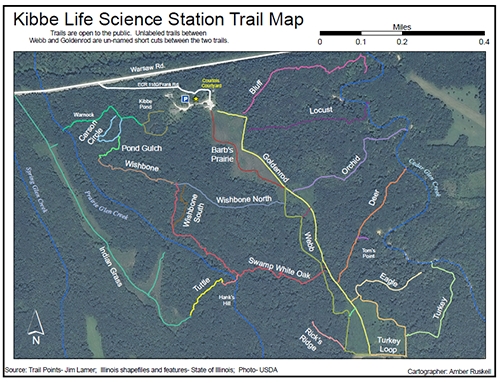
The layout of the station consists of five buildings, including a restored 19th-century farmhouse providing living quarters for the site manager and his family, and two large storage buildings used to house watercraft, machinery, and sampling equipment.
Another 19th-century farmhouse (Frank house) was remodeled and expanded to accommodate two classrooms, a kitchen/dining area, bathrooms, office space, and two small laboratories. The newest facility is a 4,200-square-foot multiple-use building with two dormitory wings that can house a total of 48 people. The building also has a modern kitchen, dining facility and showers. The whole building is handicap accessible.
The wide variety of aquatic and terrestrial communities at the Station and in the vicinity provides excellent opportunities for studies and instruction in field ecology and biology. The sandbars, islands, and sloughs of the Mississippi River are easily accessible. Floodplain forests occur along the shoreline of the river while upland oak dominated forests are located on ridges and tops of the bluffs. Limestone outcroppings and hill prairies are commonly found on more xeric exposed sites. Rocky intermittent streams are found in the valleys and hollows. Two large tracts of restored tallgrass prairie are also being actively managed at the station.
Natural Habitats
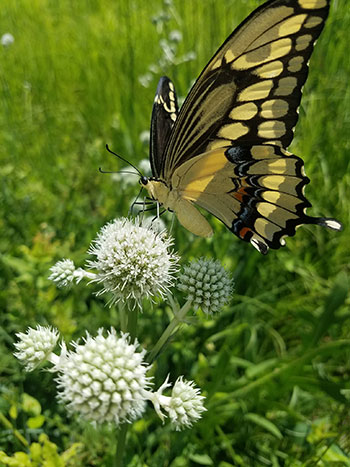
Kibbe Station is the only station of its size located on the navigable portion of the upper Mississippi River System. The management area includes 5.2 miles of river shoreline with easy access to sandbars, islands, sloughs, navigation pools and forested floodplains. Additionally, the Field Station is located on Pool 20 just downstream of Lock and Dam 19, the oldest dam on the Mississippi River and one of the most ecologically significant structures on the Upper Mississippi River.
The uplands are comprised of oak dominated forests, sand hills with xeric sand prairie, limestone outcroppings/bluffs and hill prairies. Rocky intermittent streams are found in the valleys and glens. The site represents the largest piece of continuous habitat in the area. The Sand Hills Nature Preserve, a restored oak savanna and tracts of restored tallgrass prairie are also being actively managed using prescribed fire and other techniques to promote diversity and to control invasive species.
The Field Station is a major wintering site for bald eagles, one of the largest concentrations in North America. The eagles' night roost is included in Cedar Glen Natural Area. Cedar Glen Natural Area and the rest of the lands managed via Kibbe Station operations are collectively called the Kibbe Macro site (KM). Macro sites are large areas recognized by Illinois Department of Natural Resources (IDNR) as containing large tract of ecologically significant native terrestrial and/or aquatic resources.
More than 100 plant families and 720 vascular plant species and 100 non-vascular plant species have been documented in the Macro site. Nearly 225 families of insects along with 25 species of amphibians, 25 breeding bird species and 33 mammal species occur at the site. White-tailed deer, wild turkey and beaver are abundant in the area. River otters are also returning to the area.
The adjacent section of the Mississippi River is a major flyway for migrating waterfowl and shorebirds with diving ducks, ospreys and pelicans roosting in the fall. Pileated woodpeckers nest and feed in the woodlands along the bluffs. The adjacent section of river contains the most diverse mussel sanctuary in the state. Two state-listed endangered species have been found in the sanctuary. The Station and the surrounding area offer many opportunities for students, faculty, and the public to take part in conservation, education and research projects.
Outreach and Recruitment
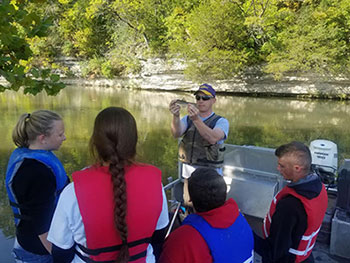
The Station is used by a variety of groups for educational, professional and outreach activities. Educational and outreach activities include K-12 school and scouting based programs, inter-agency meetings, salavisiting classes from other universities and the regular field-oriented summer classes offered at the Station. Summer courses have been offered at the station continuously since 1966. A wide variety of courses, ranging from herpetology and ornithology to field mycology and aquatic/wetlands plants, are offered during 2 four-week sessions each summer.
In addition, as part of our outreach and recruitment program, station personnel and faculty from the Department of Biological Sciences have been involved in an annual conservation day for 400 to 500 5th and 6th graders each spring. The Station has also hosted weekend conservation workshops with high school students and scout groups. At these workshops, individuals not only participate in conservation projects like invasive woody species control, prairie seed collection, electro-fishing, turtle trapping at the Station, and a prescribed burning equipment presentation, but also received instruction and mentoring, from scientists and resource managers from various state and non-profit natural resource agencies, concerning career options available in the natural resource field.
Mississippi River Beautification Program
The Station has also "adopted" two river miles to clean up several times a year as part of the Adopt a Mississippi River Mile Program of the Mississippi River Beautification and Restoration Project (started in 2001), to show continued support for the cleanup efforts on the river. Future effort and involvement in this program will convey a hands-on opportunity to promote environmental awareness and the importance of being a steward in conserving our natural resources to young people attending classes and workshops at the Station.
Volunteer
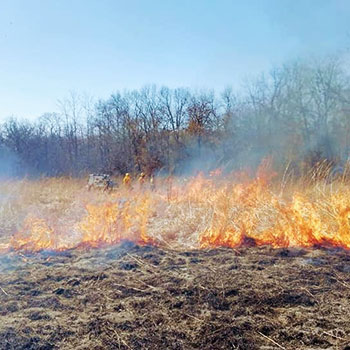
If interested in lending a hand, please contact us to see how you can become involved. Volunteers are always welcome!
Sean E. Jenkins, Director
Phone:
(309) 298-2045
Email:
SE-Jenkins@wiu.edu
Neil Gillespie, Manager
Phone:
(217) 256-4519
Email:
ND-Gillespie@wiu.edu
General public
The Kibbe Station has a strong tradition of community involvement and stewardship. Many of our prescribed burns, prairie restoration, invasive species control and station beautification projects have been historically assisted by volunteers or “Friends of Kibbe” and several of the trails have been named after some of our most highly devoted stewards. We have several opportunities for the public to help preserve our natural heritage.
College students/Internships
Throughout the year, we have many ongoing research projects in fisheries, aquatic ecology, herpetology, entomology, plant ecology, hybridization and population genetics. This field and laboratory experience includes working first hand with research scientists and graduate students. You do not need to be a WIU student to apply and lodging for interns is free in our dormitory facility. Many college biology programs give internship credit, which would need to be arranged by the student. Hands-on field experience at a research station and possible internship credit are possible.
High school students
Are you a high school student interested in pursuing a career in biology/natural resources? Volunteer at Kibbe to see what it is all about. You can gain valuable experience in field and laboratory based research. You will be assisting graduate students and research scientists in all aspects of ecological research from data collection to data processing and analysis.
Boy scouts/girl scouts
Scouting projects or service activities in ecology and natural resources are available at the Kibbe Station.
Videos
Connect with WIU: