
University News
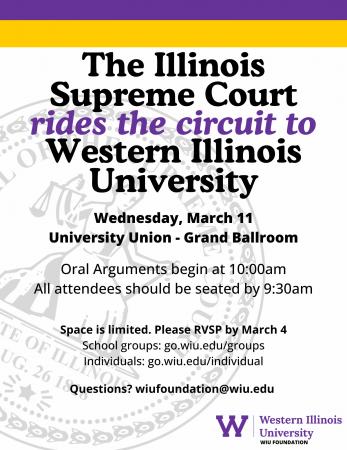
WIU will host the Illinois Supreme Court Oral Arguments on March 11 as part of the Riding the Circuit program.
[Download Print-Quality Image]
![[Download Print-Quality Image]](http://www.wiu.edu/images/news/21175/21175_14303_1.jpg)
WIU to Host Illinois Supreme Court Oral Arguments on March 11; Cases Announced
March 3, 2026


MACOMB, IL - - Western Illinois University hosts the 2026 installment of the Illinois Supreme Court's Riding the Circuit program as justices hear oral arguments in two cases beginning 10 a.m. Wednesday, March 11, in the University Union Grand Ballroom.
In People v. Marshall (No. 132129), the Illinois Supreme Court is deciding whether, under the state's Pretrial Fairness (SAFE-T) Act procedures, a defendant who fails to raise an issue in a required trial court motion before appealing has permanently waived that issue or merely forfeited it, meaning an appellate court could still review it in limited circumstances. The decision will clarify how strictly courts apply appeal rules in pretrial detention cases.
In E.W. v. Board of Education of East St. Louis School District #189 (No. 131757), the Illinois Supreme Court is deciding whether state law requires a public school district to go beyond its existing bus routes to transport eligible private school students, or if it only must provide transportation along its regular public school bus routes. The ruling will clarify how far districts must "extend" transportation services for private school students under Illinois law.
"We are thrilled to welcome the Illinois Supreme Court to our campus for this incredible event," Interim Executive Director of Advancement and Alumni Relations Amy Crosby said. "The day will provide an unparalleled opportunity for local students and the WIU community to experience the judicial process in action."
Arguments will begin at 10 a.m. in the Grand Ballroom and will be livestreamed on the University's YouTube channel at bit.ly/WIURidestheCircuit. Ballroom doors will open at 8:30 a.m., and all attendees are encouraged to arrive by 9:30 a.m. A moderated question-and-answer session with 9th Judicial Circuit Court Judges Heidi Benson and Nigel Graham, along with attorney Emily Sutton, will follow the oral arguments.
"Holding the Supreme Court's oral arguments at Western Illinois University continues a tradition of openness and public education," Chief Justice P. Scott Neville, Jr said. "Seeing the process firsthand helps demystify the courts and their role in daily life."
Illinois Supreme Court Justice and WIU alumna Mary K. O'Brien '86 shared in Crosby's and Chief Justice Neville's enthusiasm for the event.
"I have so many fond memories of my time here at Western Illinois University. To return home nearly four decades later alongside my colleagues on the Supreme Court is a profound honor," Justice O'Brien said. "We hope to show the WIU community that the Court is a transparent forum where every argument and action is tested against the framework of the Illinois Constitution and the rule of law, which ultimately serves as the bedrock of our free society."
Backpacks, water bottles and other large items or bags will not be permitted in the Ballroom.
For the event, Parking lot 16 (Union lots, including the metered spaces), will be closed to the public beginning 11 p.m. Tuesday, March 10. The lots will reopen around 3 p.m. Wednesday, March 11.
Murray Street, from Sherman Drive through Western Avenue, will also be closed to through traffic from 7:30 a.m.-3 p.m. on Wednesday as a designated drop-off/pick-up area for bus traffic.
Area middle and high schools are invited to bring students. Schools interested in attending can RSVP at go.wiu.edu/groups by Wednesday, March 4, or contact Crosby at al-crosby@wiu.edu. Several hundred local students are expected to attend.
A limited number of seats are available to the public. Those interested in attending should RSVP at go.wiu.edu/individual by Wednesday, March 4 or contact the Director of Donor Relations and Special Events, Drew Donahoo, at am-donahoo@wiu.edu.
Since 2008, the Supreme Court has held oral arguments in locations across Illinois to raise awareness of the role courts play in interpreting state law. The practice of holding Supreme Court arguments outside Springfield dates back to an old tradition called "riding the circuit." It began in medieval England, where judges traveled to local communities so people could see the law at work. The United States adopted the same idea at its founding, requiring Supreme Court justices to travel so the public would understand and trust the new courts. Illinois followed this practice after becoming a state in 1818, until the 1848 Constitution ended it. Today, traveling Supreme and Appellate Court arguments still serve the same purpose: bringing the judiciary closer to the people.
This program is sponsored by the Illinois Supreme Court, the Administrative Office of the Illinois Courts, the Supreme Court Historic Preservation Commission, the WIU Foundation, the College of Arts and Sciences and the Department of Political Science.
Posted By: University Communications (U-Communications@wiu.edu)
Office of University Communications & Marketing
Connect with us: