
Counselor Education, College Student Personnel, & Social Work

Counselor Education Graduate Programs
Master of Science in Education (M.S.Ed.)
Our Mission Statement:
"Counselors teaching counselors: knowledge, development, inspiration, and transformation."
Our Vision Statement:
The Counselor Education programs at Western Illinois University - Quad Cities will be the leader in educational quality, opportunity, and affordability among its peers.
Our Program Objectives:
Through training and applied practice, WIU counselor education students will:
- Develop effective, evidence-based, ethical, and multicultural clinical skills by
- Infusing theory into practice
- Considering clients holistically
- Advocating for client well-being
- Develop strong professional counselor identity with a comprehensive integration of the student’s chosen specializations by
- Engaging in and maintaining membership and leadership in professional organizations
- Adhering to and demonstrating ethical principles and practices
- Advocating for the profession
- Become reflexive practitioners who understand their values and identities in order to
- Acknowledge their role in community-based social justice.
- Evaluate and address the unique needs of marginalized populations.
- Collaborate with community organizations through practical experiences.
- Acquire skills to work with intersectional identities through clinical placements.
Our Program Highlights:
- Pursue a counseling career with CACREP-accredited tracks in Clinical Mental Health and School Counseling and learn from experienced faculty who have served as counselors in diverse environments, including schools, community mental health centers, recovery facilities, and hospitals.
- Gain strong academic preparation, hands-on clinical experience, and real-world client engagement in partnership with local school districts and community agencies to meet licensure requirements.
- Flexible course scheduling in the late afternoon and early evening accommodates working professionals.
CNED Graduate Program Coordinator
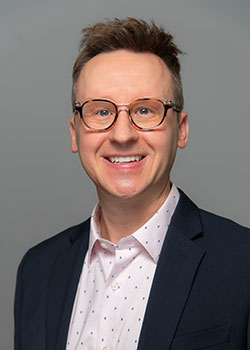 Dr. Matthew Beck, Ph.D., LCPC, NCC, ACS
Professor, Counselor
Dr. Matthew Beck, Ph.D., LCPC, NCC, ACS
Professor, Counselor Education Graduate Coordinator Office Location:
QC Complex Bldg C, Room 2413 Email: MJ-Beck@wiu.edu Phone: (309) 762-1876
School Counseling Program
In order to develop as effective school counselors, students will:
- Demonstrate an understanding of school counselor identity and roles as leader, advocate, consultant, collaborator, and systemic change agent, especially in supporting under-resourced and marginalized populations
- Be prepared to meet and implement all academic and clinical requirements to be eligible for professional licensure as a school counselor
- Learn to create and implement a comprehensive school counseling program that highlights the intersection of students’ academic, post-secondary, and personal/social considerations through an MTSS framework and data-driven practices
- Recognize and adapt core counseling skills and techniques to apply in the school setting.
Clinical Mental Health Counseling Program
In order to develop as effective clinical mental health counselors, students will:
- Be prepared to meet and implement all academic and clinical requirements to be eligible for professional licensure as a mental health counselor
- Demonstrate strong clinical skills in case conceptualization, diagnosis, documentation, and treatment planning related to a variety of clinical settings
- Develop an understanding of programmatic design, evaluation, and implementation in clinical mental health settings
- Demonstrate an understanding of clinical mental health counselor identity and roles in the delivery of services within multiple settings including advocacy and leadership responsibilities
Methods of Instruction
The Counselor Education Program offers both didactic and clinical curricular experiences. Courses are offered in face-to-face, hybrid, and online modalities. Instructional methods include, but are not limited to lecture, case studies, discussion forums, role-plays, and the use of audio/visual media.
Admissions Information
Connect with us: