
College of Education & Human Services
WIU Home > COEHS > School of Education > Grad > Mat
Master of Arts in Teaching (MAT) - Alternative Licensure
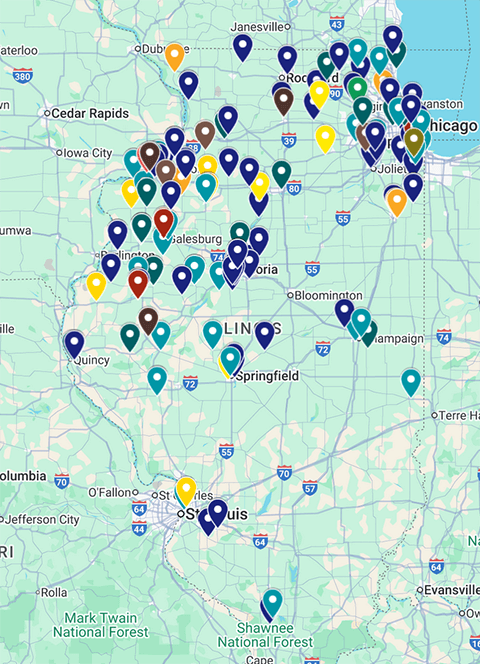
The Master of Arts in Teaching (MAT) - Alternative Licensure is a one-year residency program wherein candidates are hired by a school district on a provisional teaching license, are paid a beginning teacher salary, and take courses online (asynchronous and synchronous) toward the completion of a graduate degree and a Professional Educator License in Illinois. Since 2021, WIU's MAT Residents have found jobs in over 180 schools across the state.
Upon successful completion of the program, graduates will receive an Illinois Professional Educator License in one of the following areas:
- Early Childhood (Birth-Grade 2)
- Elementary (Grades 1-6)
- Middle Grades (Grades 5-8) Language Arts, General Science, Social Science, or Mathematics
- Music (Grades PK-12)
- Physical Education (Grades PK-12)
- Secondary English (Grades 9-12)
- Secondary History (Grades 9-12)
- Secondary Mathematics (Grades 9-12)
- Secondary Science (Grades 9-12): Biology, Chemistry, Physics, Earth, or Space Science, Environmental Science
- Special Education (Grades K-Age 22) - Learning Behavioral Specialist (LBS1)
- Visual Arts (Grades PK-12)
- World Language: French (Grades PK-12)
- World Language: Spanish (Grades PK-12)
Eligibility
- Document a minimum of 2 years of post-baccalaureate work experience or acquire a waiver from a school/district.
- For the early childhood, elementary, or special education licensure areas, applicants must have a bachelor's degree from an accredited university with 32 semester hours (s.h.) combined in language arts, math, science, and social studies coursework.
- For all other licensure areas, applicants must have a bachelor's degree from an accredited university in the content area of licensure sought; or a bachelor's degree with 32 s.h. in the content area sought.
- A minimum of 9 semester hours, in the area that licensure is sought, is needed to start the program. The remaining s.h. must be completed by the end of the program and in some instances, may be satisfied with MAT coursework.
Procedures for Applying to WIU
- Apply for admission. Select Master of Arts in Teaching - Alternative Licensure as your area of study. Specify the licensure area of interest. You must meet the general admission requirements of the School of Graduate Studies and have a minimum cumulative GPA for all undergraduate work of 2.75.
- Our Coordinator of MAT Residency and Licensure, Kristen Barclay, will review your transcripts for eligibility into the program. She will let you know if you are eligible for the licensure area you selected during your application and indicate any deficiencies that must be completed to be considered for licensure.
- Within about two weeks, one of the MAT Coordinators will receive notice of your application and will contact you to make arrangements for an intake meeting.
- Within 7-10 days after your intake meeting, you will receive a welcome email from the School of Graduate Studies containing important new student information. Watch your email account for this.
- Set up the necessary email, ECOM username, and password, and communicate that account information to MAT@wiu.edu so that you will have access to the MAT Portal.
- Register for courses via STARS. STARS Help is available Monday-Friday from 8 AM to 4:30 PM (Central time). Contact your advisor with any questions about courses. Students may begin taking courses before beginning their residency. There is no limit to the amount of coursework that can be completed before residency.
- Begin working on your licensure checklist items.
Deadlines for Application
Graduate School applications and all transcripts will need to be submitted by the following dates to ensure enrollment in classes:
- Fall Semester: August 1
- Spring Semester: December 15
- Summer Session: May 1
Procedures for Getting an Educator Licensure with Stipulations endorsed for Alternative Provisional Educator (ELS-APE)
- Document a minimum of 30 hours of PAID teaching (such as subbing or aiding) experience within the last 5 years and write a reflective paper on that experience. Those without experience in schools take 2 s.h. of EDS 592: Field Experience.
- Complete online training modules in lesson planning, assessment, ESL, and classroom management.
- Complete School Safety Training and Mandated Reporter Training.
- Pass applicable Content Tests (http://www.il.nesinc.com/)
- Apply for open teaching positions via IASA Illinois Education Job Bank and Unfilled Positions or through connections in your local area. Note that hiring authorities will require a background check.
- Secure a full-time teaching job that requires the license you are pursuing. Positions must be with schools or organizations that have a PEL authorized supervisor (principal) in the building and where at least 50% of teachers have their PEL.
- Work with the WIU Coordinator of MAT Residency and Licensure to receive your ELS - APE.
Once You Have the ELS-APE
- Begin a one-year residency program as a paid teacher of record with the support of a mentor teacher and a university supervisor while completing program coursework.
- Be evaluated by the MAT coordination team and the school principal after the first year of residency to determine if a second year of residency is needed. (See ISBE Guidelines for Alternative Route programs.)
- Complete required coursework in the MAT program for the licensure area sought (program degree plans).
- To qualify for a full Professional Educator License, students must be approved through the evaluation of their principal and university supervisor, and complete any coursework deficiencies indicated through the eligibility process by the end of the program.
EDS 600: Internship in Teaching
EDS 600 is a two-semester clinical course held weekly via Zoom that provides peer connections, mentoring, professional development and coordination of paperwork associated with residency. All residencies begin with the start of the Fall semester and conclude with the end of the following Spring semester. So long as the licensure checklist items have been completed and the teaching residency is approved by the deadlines below, students receive an ELS-APE in July and register for 2 s.h. of EDS 600: Internship in Teaching for the following Fall semester (and 2 s.h. for the following Spring semester). Once enrolled in EDS 600, the MAT Candidate becomes an MAT Resident.
Deadlines for Submitting Provisional Licensure Material to Begin Residency +
- To begin a residency each Fall/August, you must pass the relevant content exam by the preceding June 15.
- Submit all other licensure checklist materials to the MAT Portal* by July 1
+Only accepted students can submit materials for residency.
*Access will be granted upon acceptance into the program
Frequently Asked Questions
How do I know which teaching areas I am eligible for?
After you apply to the program, our Coordinator of MAT Residency and Licensure, Kristen Barclay, will review your transcripts for eligibility into the program. She will let you know if you are eligible for the licensure area you selected during your application and indicate any deficiencies that must be completed to be considered for licensure.
Are international students eligible for the program?
We are currently not accepting any international students into the Master of Arts in Teaching/Alternative Licensure program who are on the F-1 student visa. Our MAT program is 95% online classes, which does not work for International students on an F-1 student visa.
Our MAT program does not have the resources to assist international teachers/students with their work visa or job/teaching placements. If a school district in Illinois is the sponsoring agency for the MAT teacher/student, then our program can work.
We do have two MS degrees that international students are able to enroll in if they wish to complete a degree completely online and from outside the USA:
Do I need to have a teaching license to do this program?
No. This program is for people with a baccalaureate degree who wish to get a teaching license along with a master's degree through an alternative route program. Students work as paid teachers of record under a provisional license while earning their full PEL.
Can the program be completed online?
From inquiry through graduation, our faculty and staff will support you remotely. All courses are completed online without the need to come to campus. Although a few of the courses have synchronous meeting times, they will be virtual (usually Zoom) sessions. The teaching residency is the only “in-person” portion of the program.
Do I have an assigned advisor or mentor?
The School of Education will assign you an advisor who can help you with the completion of your coursework, answer questions and resolve degree-related problems, and monitor your academic progress. The university will assign you a supervisor who will meet with you regularly during your residency. You will also be a part of EDS 600, which is structured as a cohort group support experience, with brief reflection assignments and regular Zoom meetings. Your hiring district or organization will assign you a mentor or a coach. These mentors, along with your building principal, will support you as a new teacher.
Who is my advisor?
You will find a list of program advisors in the MAT Handbook.
Do I have to pass a test?
Yes. All candidates must pass a content exam corresponding to the area of licensure sought. For more information, see the ILTS resource webpage.
Do I need to pass the state content test before taking the classes?
No. Passing the content exam is a requirement of residency. It is part of the Licensure Checklist.
Are the content exams difficult?
Many students choose to take one or two months in order to study for their exam. Although some students require multiple attempts, many are able to pass it on their first try. If you don’t pass it immediately, don’t worry! For students who do not have much experience teaching in their chosen licensing area, taking a few relevant courses in their program before attempting the content test is usually a good idea. Check with content area experts on the faculty for advice on which courses might be helpful. Admitted and enrolled students will be notified of the availability of test preparation sessions. Visit the ILTS resource webpage to get started.
How do I prepare for the exam?
Access the Illinois Licensure Testing System (ILTS) Website. It contains information about each content exam as well as study materials. Select your Content Test name in the pull-down menu and hit the GO button. Review the materials, especially the information under #3, titled What's On The Test. It gives a breakdown of the test construct and the concepts on the exam so that you know exactly what you need to know. Once you register for the test, you will get a free practice test. Take the practice test and focus on any questions that you got wrong. Talk to your advisor about other program specific resources.
Can I begin taking classes before I obtain my temporary license and begin working as a teacher? Do I need to start classes at the same time I start the residency (internship/student teaching)?
Many students choose to take classes before applying for their provisional license (ELS-APE) in order to prepare for their content exam and/or lessen the load during their residency. (Please check with your advisor about courses that may require that you have access to students in a classroom.) Students may also want to take courses before their residency because of other life obligations that they will have during their residency. Keep in mind that all students can take advantage of summer semesters to take courses without a teaching obligation. Finally, the ELS-APE is only good for two (2) years and can only be renewed for one additional year. This reason alone could make taking some courses before getting a license a smart move.
How much does the program cost? Is financial aid available?
Total costs for the program are approximately $20,000. This fluctuates slightly depending on your specialization and how many credit hours you take. There are a number of financial aid programs available, including the federal TEACH grant, which provides up to $8,000 for a master’s level licensure program. Remember that you will be earning a full-time teaching salary once you begin your residency.
How long does the program take?
Students progress through the program at their own pace, but they must complete a one-year residency and all of their courses before they can graduate and earn their PEL. It would not be possible to complete everything in one year, but perhaps in two if students take summer courses as well.
Is there a minimum number of classes I have to take each semester? Or how many courses can I take at a time?
No. There is no minimum number of courses to take each semester, though we recommend taking no more than two courses per semester in addition to your EDS 600 credits.
Can I bring in coursework from another university?
Yes. The University allows students to transfer up to nine semesters of coursework that has not been used for a previous degree from accredited institutions. However, there are no elective courses in the MAT program. Courses that you bring in must first be approved for substitution of an equivalent required course. You must provide the syllabus of the course that you wish to transfer. And you must have earned a C or above in the course to use it for licensure and the MAT degree. Contact your advisor if you think you may have already taken coursework that is equivalent to the required coursework in your MAT program.
What is a teaching residency?
The residency is a paid teaching position whereby you are considered a fully qualified teacher. You will have a mentor at your work site and a university supervisor who will visit you, but you will not have a supervising teacher. You will be the teacher of record.
How long is the residency?
Students must complete one full school year (two semesters, Fall to Spring) of residency teaching. The one-year residency clock starts only after students have their ELS-APE entitled. Full-time substitute teaching or any limited contractual teaching (certified hourly instructors, transitional bilingual educators, visiting international teachers) completed without an ELS-APE license cannot be counted toward the residency time. Likewise, support teaching and teaching done as a paraprofessional will not meet the requirements of a residency position.
Does WIU place me in a teaching job for residency?
No. MAT candidates are responsible for finding their own residency placements. The need for teachers varies. Not all school districts need teachers in all licensure areas. Consult the IL Education Job Bank for open vacancies.
How do I find a teaching job?
Many of our students are already working in schools or have a connection to their local community districts. For those who are entering the education workforce for the first time, we require a short observational field experience in a classroom, which can be satisfied with 30 hours of substitute teaching. Substitute teaching is an excellent way to find out about future openings in your local schools. To find open positions statewide, we suggest using the free Illinois Education Job Bank, where you can search for jobs, save resumes, and apply online. Please note that WIU does not place MAT students in teaching residencies and cannot provide assistance in locating open positions. The MAT program was created to respond to the teacher shortage in Illinois. Our schools need teachers.
When do I get my provisional teaching license?
We entitle the ELS-APE each July to coincide with the start of residency the following Fall semester. This means that students can only begin their teaching residencies in August, which is typically when the school year starts. Once all your Licensure Checklist materials have been approved, someone from the Office of Teacher Education will issue your provisional license (ELS-APE) and send you an email about when you can go into your ELIS account and apply for and pay for it.
We only issue the ELS-APE license AFTER you have secured a teaching position. This is because the ELS-APE license is good for just two (2) fiscal years: July 1, 20xx-June 30, 20xx. The license may be renewed for a third year if necessary.
Where does the temporary license allow me to teach/What positions can I accept?
With the license, you can work at any Illinois institution where at least 50% of the teachers possess a state license, and at least one administrator possesses a state principal license. The ELS-APE license will only be issued for full-time positions as the “teacher of record”. These are positions that require a Professional Educator License or an Alternative Provisional License (ELS-APE) and the content exam for the licensure area sought. Full-time substitute teaching or any contractual teaching completed without a provisional license cannot be counted toward the residency time. Likewise, support teaching and teaching done as a paraprofessional will not meet the requirements of a residency position.
What subjects or grades can I teach with my provisional license?
Teaching assignments must be 100% in the area and grade level for which the ELS-APE license is held. Shared teaching appointments with areas/grade levels outside of the content areas or grade levels are not permitted. Special Note about Elementary Positions: An Elementary position would require teaching in grades 1-6. Residents are expected to teach in all of the four elementary academic areas (ELA, Math, Science and Social Studies).
When do I start teaching?
All residencies start at the beginning of the Fall semester (August) and culminate at the end of the Spring semester. To begin the teaching residency, students must have all items on the Licensure Checklist completed and submitted by the deadlines of each year. Those deadlines are June 15 for the content exam and July 1 for all other licensure checklist items.
When do I register for EDS 600?
In July, before your residency begins, someone from the Office of Teacher Education will let you know that it is time to register for your first two credits of EDS 600. Don't worry. EDS 600 does not fill, so you will not lose a "seat". At the end of the Fall semester of your residency, you will be notified when to register for your subsequent EDS 600 credits.
Can I pursue more than one license at the same time?
No. The ELS-APE is good for just one licensing area. While you may be interested in (or even working toward) additional endorsement areas, you will have to do your residency teaching in the area dictated by your ELS-APE license. Once issued, the ELS-APE cannot be changed to a different licensing area.
What if I want to switch my licensure area?
You may switch licensure programs at any time before your ELS-APE license is issued. Once issued, an ELS-APE cannot be changed to another licensure area. However, you could complete the coursework necessary for a subsequent endorsement to teach in another area. That endorsement will be attached to your PEL once you finish the MAT coursework and residency in your original licensure area.
Each licensure program has different course requirements. All programs require EDS 457G, most require SPED 551, and many require a multicultural education component. Before you decide to switch programs, check out the requirements in the MAT Handbook. Please also note that the content test is different as well.
To switch programs, complete this Change of Status Form. And be sure to let your advisor know that you are making the change.
When do I get my full PEL?
You will receive your Professional Education License (PEL) along with graduation from the program, after you complete all MAT program coursework and your residency. You will receive a Master of Arts in Teaching (MAT) degree at the same time.
MAT Student Resources
MAT Handbook
This resource is continually updated with program information and licensure policies. Please access the information from this link rather than printing it as a PDF for saving or distributing.
Licensure Checklist
Content Exam Information
Illinois Licensure Testing System
The Illinois Licensure Testing System (ILTS) website contains information about each content exam as well as study materials. Select your Content Test name in the pull-down menu and hit the GO button. Review the materials, especially the information under #3, titled What's On The Test. It gives a breakdown of the test construct and the concepts on the exam so that you know exactly what you need to know. Once you register for the test, you will get a free practice test. Take the practice test and focus on any questions that you got wrong. Talk to your advisor about other program specific resources.
MAT Degree Plan Templates
Use the list of courses found on the degree plan when determining your program of study. Use these templates to keep track of your course progress. MAT Candidates will submit their completed degree plans as part of EDS 600.
Graduate Course Projections
MAT Enrollment Projection Schedule
Use the MAT Enrollment Projection Schedule to identify when a course is set to run for a given semester and year. Each "X" represents when a particular course is set to run for a semester. Match the semester/year with the name of the course to identify the next time it will be offered. Discuss with your advisor the schedule at the onset of your program to ensure courses on the degree plan are included.
Cost Analysis
View a cost analysis based on Special Education, our most popular program.
Financial Aid Information
Available MAT-eligible grant and scholarship programs
Contact the Financial Aid Office with any questions about student loans.
Waiver for the 2 year Post Bac Work Experience
This is for students who are beginning residency within two years of graduation from a bachelor’s program.
Memorandum of Understanding
2026-2027 Memorandum of Understanding
[Note- Save the PDF file. You must have the newest version of Adobe Acrobat Reader to be able to save your document or complete the application in one of the computer labs on campus that already has the newest version installed.]
MAT Coordinator

Dr. Andrea M. Hyde
Office: 220 Riverfront Hall, QC Campus
Email:
AM-Hyde@wiu.edu
Phone: 309-762-9481
Coordinator of MAT Residency and Licensure
Kristen Barclay
Office: Horrabin Hall 40
Email:
KK-Barclay@wiu.edu
Phone: 309-298-2117
In The News!
Tiffany Piehl wins "Why Moline"
Tiffany Piehl, Master of Arts in Teaching (MAT) student and Special Education Teacher in the Moline-Coal Valley School District, receives the "Why Moline" (Why Moline Coal Valley School District is a great place to serve) award. Recipients of the "Why Moline" award are nominated by their peers. Ms. Piehl says "I feel very fortunate to be receiving the education and guidance that I have been given through the MAT program. This MAT program has been such a blessing for me. I have learned so much and grown as an educator."
Tamika Causley is in the news!
Click here for the full article by Peoria 25 NEWS (Mar. 15, 2022). Excerpts from the article read: "A longtime Peoria Public Schools employee is seeing her dream of becoming a teacher come true. After years working in various positions at PPS, Tamika Causley will become a PPS teacher next Fall, after making a strong impact on her coworkers and her bosses over the last eight years. “I need to be a teacher,” Causley said. “This is what I need to do.”
She is currently working on her master’s degree in Special Education from Western Illinois University.
Connect with us: